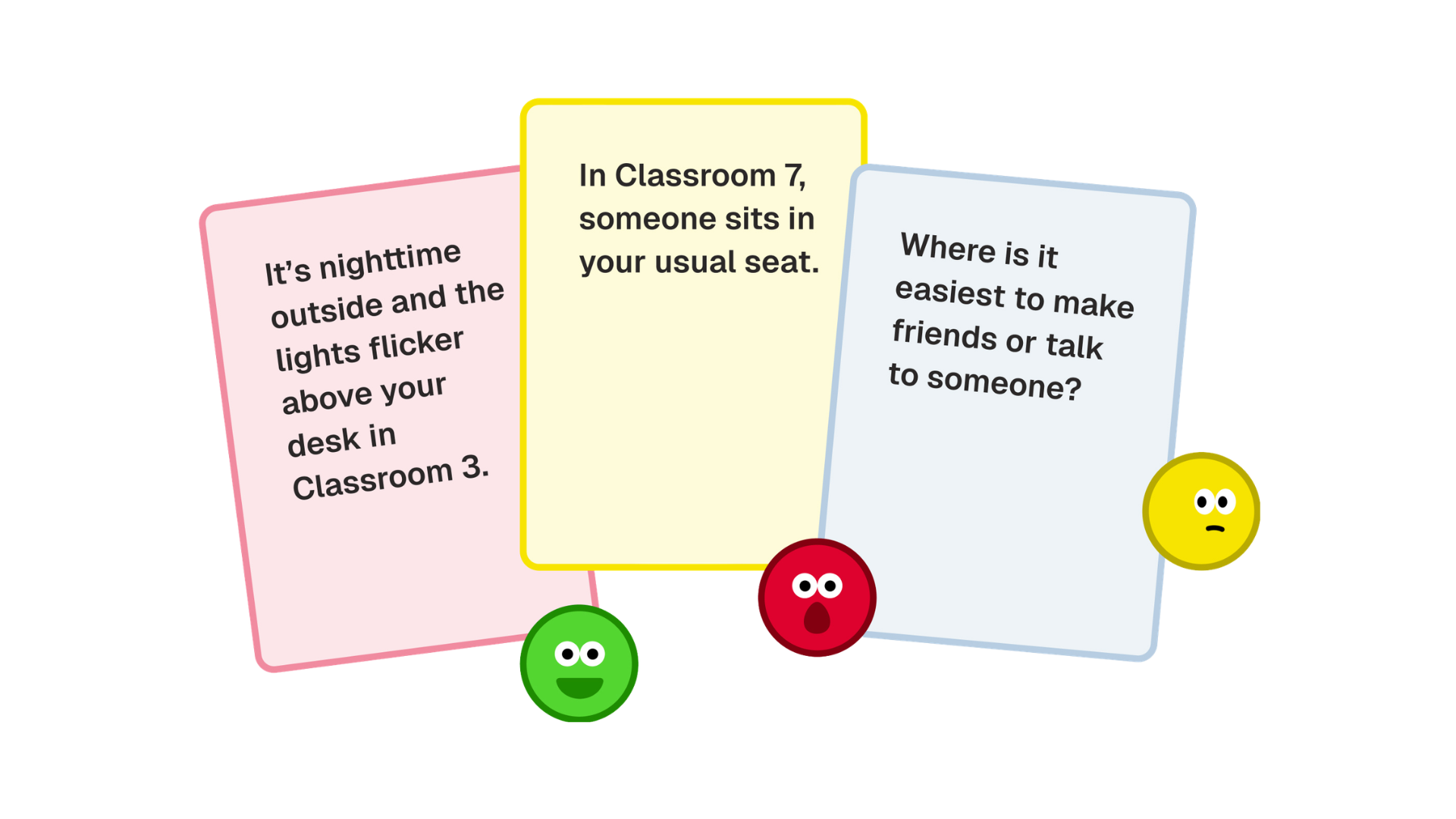
Event cards and the emoji tokens players place on the map.
- Course
- Design Research Methods for Participation
- With
- Gorjan Radeski
- Role
- Researcher, game designer, facilitator
- Format
- Peer learning session, 7-minute play activity
- Year
- 2025
- Place
- LUCA School of Arts, Belgium
Brief
How can gamified design research reveal the everyday comfort needs of neurodivergent children in school?
For the peer learning session, we explored gamification as a participatory research method with children. To demonstrate this approach, we created CareQuest, a research game designed to uncover the comfort needs of neurodivergent children through play, enabling them to express through creative, embodied participation.
Why not a survey
Traditional research asks children to explain. Play lets them show.
Children communicate through doing, playing and imagining rather than abstract reflection. Games give them familiar structures, rules, roles and rewards, that lower anxiety and open up expression. Play also shifts their position: they become co-researchers rather than subjects.
It invites play.
Research becomes a low pressure space, which matters when the participants are children or the topic is sensitive.
It builds safety.
Children can project and role-play instead of having to state feelings directly.
It reveals hidden layers.
Choices, movement and placement surface needs that words often miss.
The game
Emotion Expedition
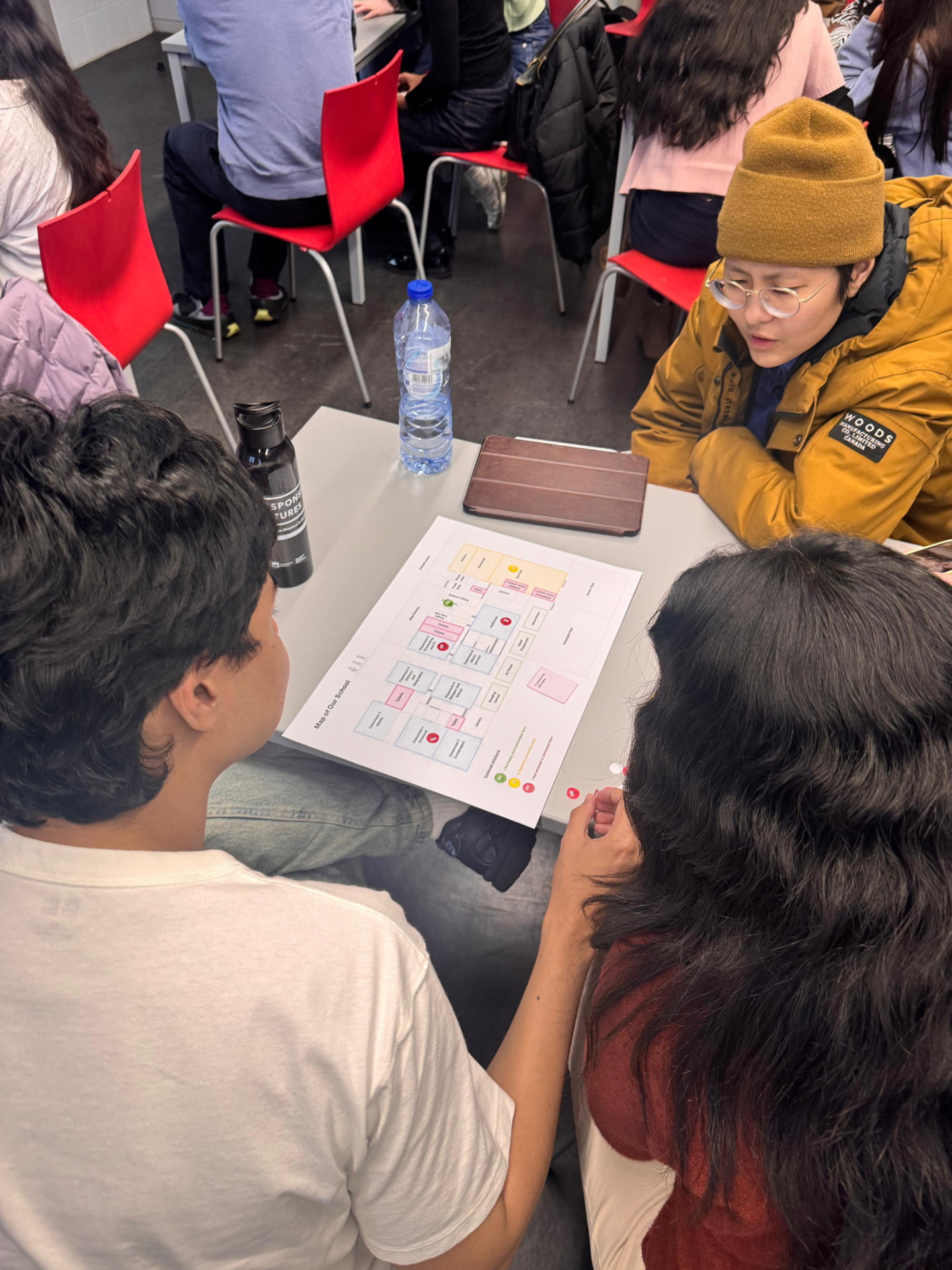
We built the session around one playable activity: a school floor plan, a deck of event cards, and a set of emoji stickers. Each card describes an ordinary school moment. Players place how it feels onto where it happens.
Form groups
Four groups, each with one facilitator. Everyone else plays children in a school, including neurodivergent children.
Draw a card
The facilitator reads an event card aloud. A flickering light. Someone in your usual seat. A place to make friends.
Place the feeling
Players stick emoji tokens on the school floor plan where the scenario lands for them.
Capture and move on
The facilitator photographs the map with the card, then the next card is read.
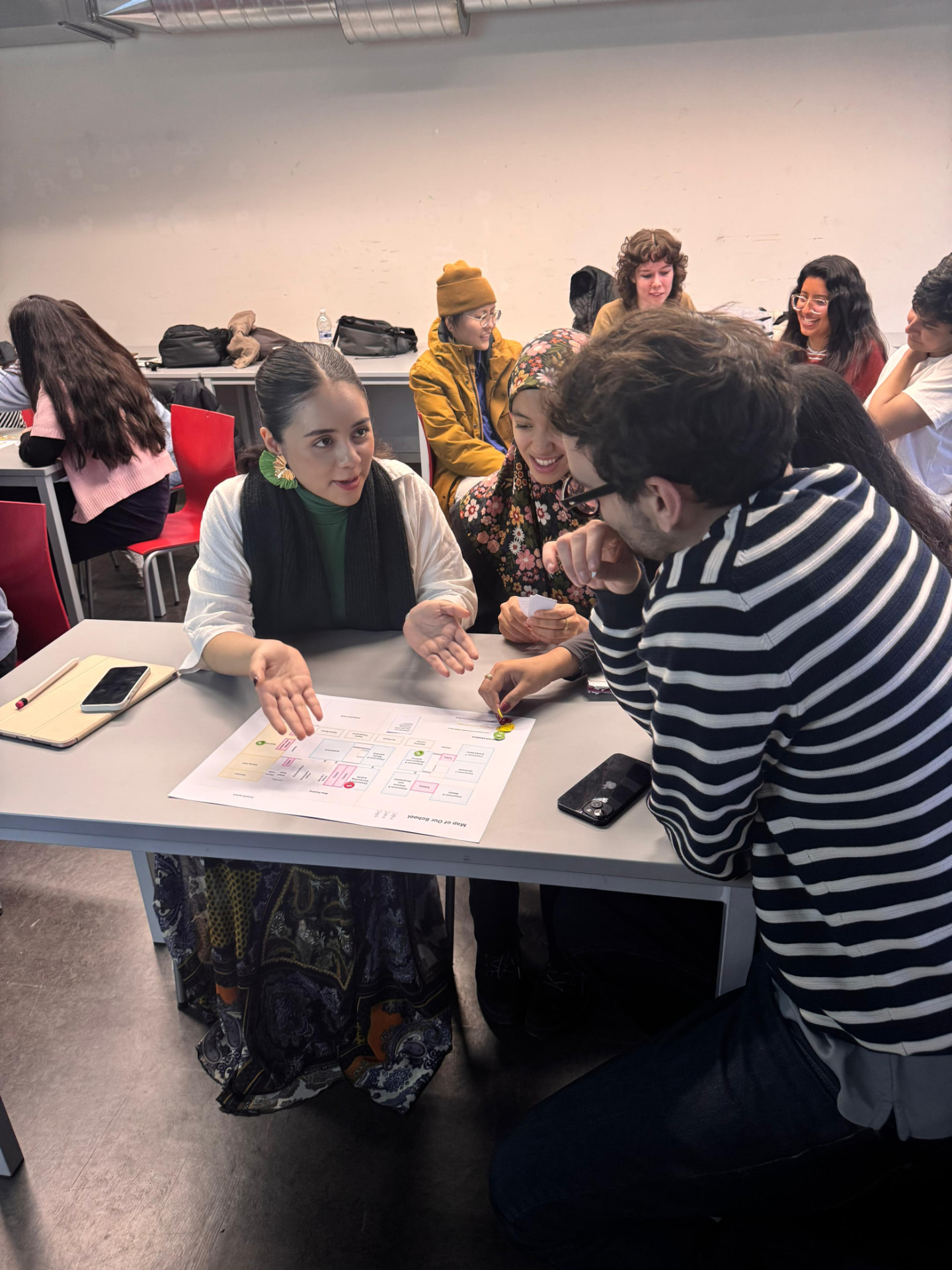
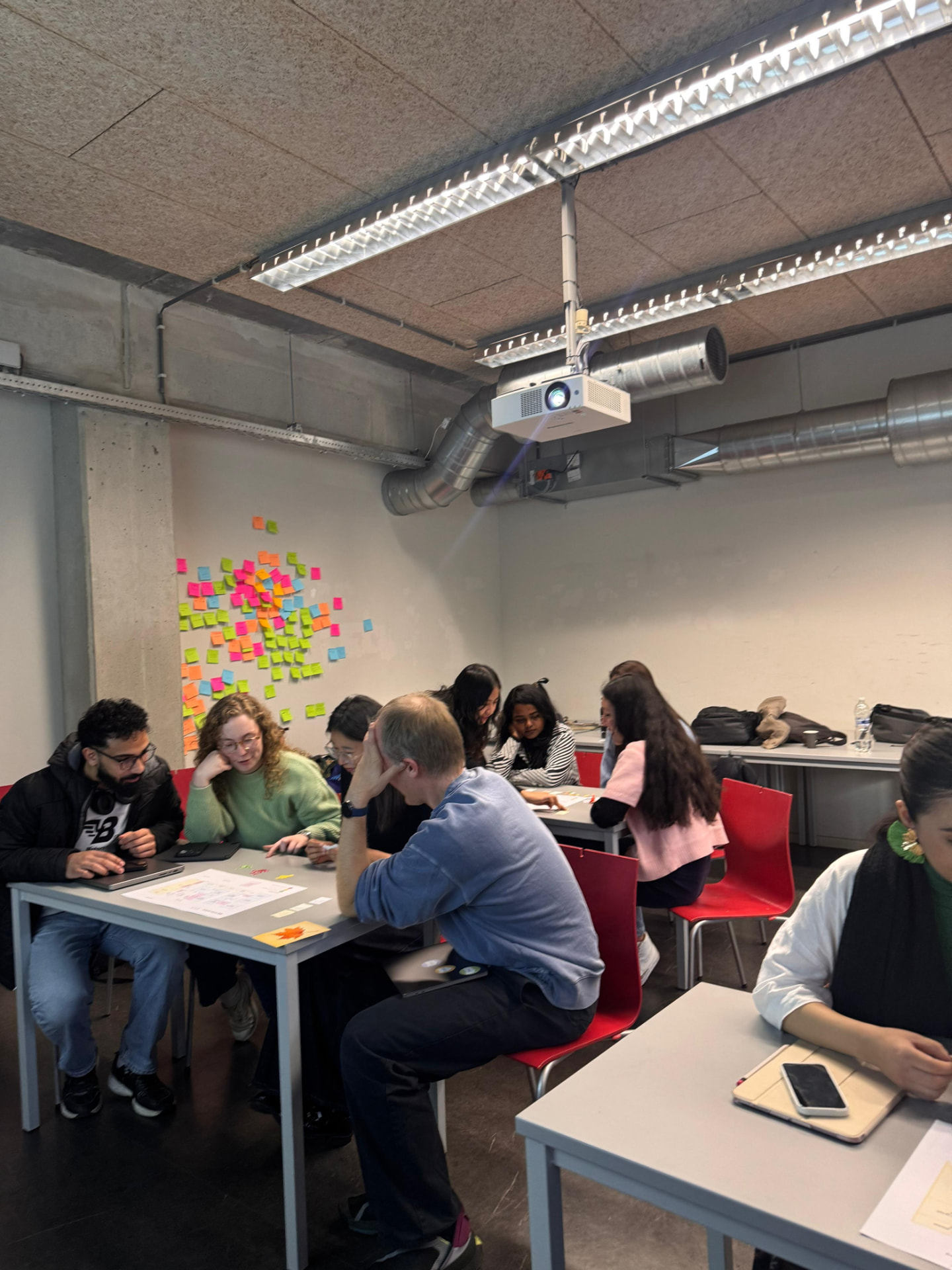
The room
Classmates playing, placing, arguing.
Our peers played the children. Within minutes the tables were negotiating: where the red sticker really belonged, whether the gym was loud or safe, who got to decide.
Reading the play
An emotion heatmap of a school.
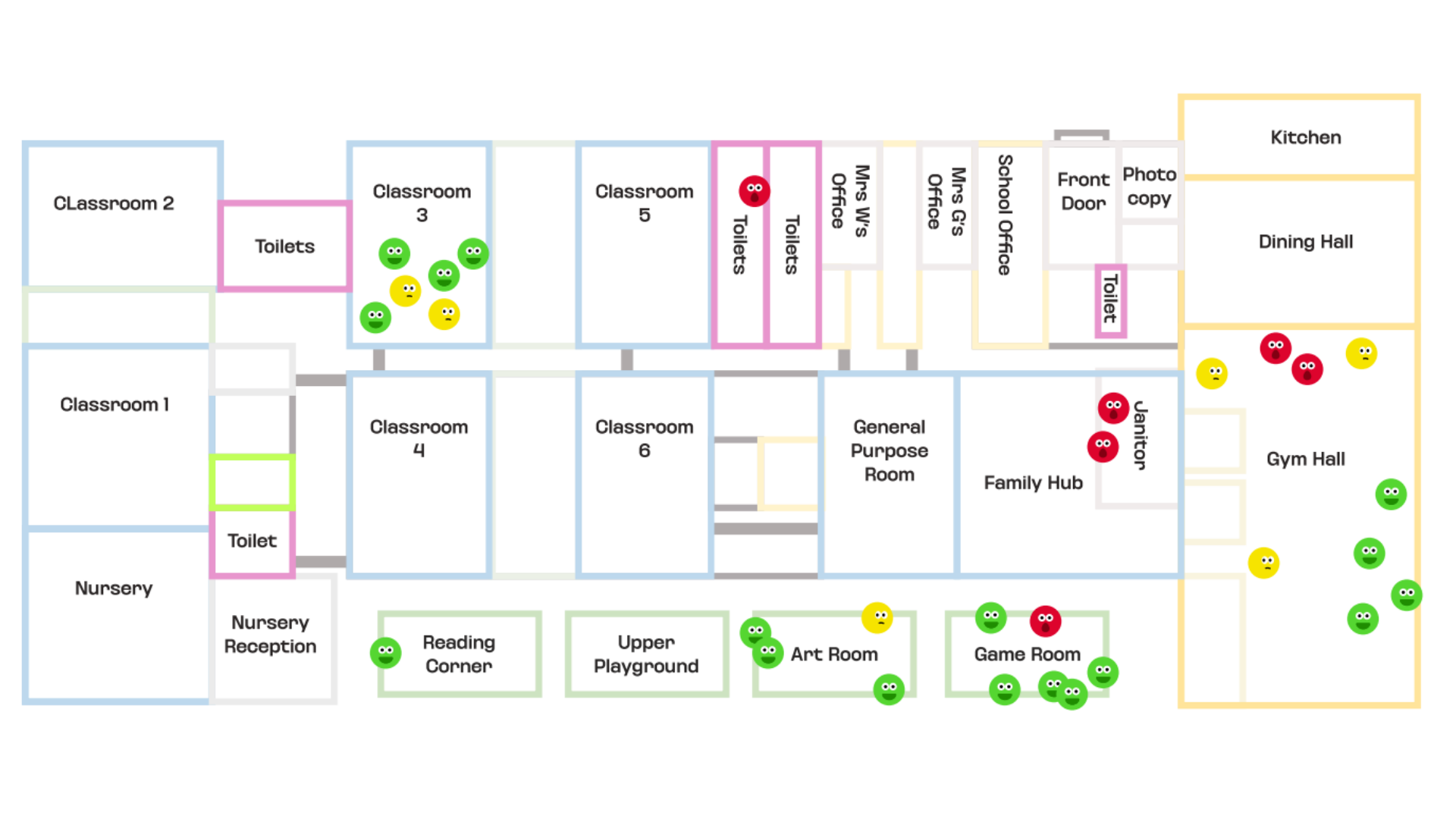
- Comparing photographs across cards shows how the same space shifts emotionally with context.
- Patterns give a sense of how children feel about specific rooms as well as specific scenarios.
- It works best layered with gamified interviews and co-design sessions for depth.
Open questions
What the room argued about.
- 01
How accurately does a gamified activity reflect real student emotions?
- 02
Are there biases in how facilitators guide the play?
- 03
How do we read conflicting emotions in the same space?
- 04
Does anonymising the data help, or does individualising it tell us more?
- 05
Which emotions point to the most urgent design interventions?
- 06
Are quieter, less engaged children still being heard?
Risks and limitations
Play is not a neutral instrument.
Oversimplification
Comfort, anxiety and trauma cannot be reduced to game rules or outcomes.
Misreading behaviour
Smiles and laughter can mask stress or confusion.
Performing for the researcher
Players may aim to win or to please rather than to express.
Accessibility
Sensory, physical or cognitive differences can make some game elements harder to join.
Ethics
Playful methods still collect sensitive data. Consent, comprehension and debriefing stay essential.
Never on its own
Gamification needs interviews, observation and reflection alongside it to hold up.
What we learned
Seven minutes taught us plenty.
Watching classmates play the school floor plan made the value of the method visible almost immediately. The map turned a conversation about feelings into a conversation about places. A child could point to the corridor or the cafeteria and say "here" long before they could articulate anxiety or comfort in words.
The floor plan did the heavy lifting.
The printed school map gave players a shared reference. Disagreements about sticker placement became useful data about how the same space can mean different things to different children.
Emoji tokens carried more than one meaning.
A green happy face could mean safety, relief, or simply that the group wanted to move on. We learned to read the photograph alongside the room, not as a standalone answer.
Facilitation changed the output.
Some groups rushed through cards; others lingered and argued. The quality of insight depended on how the facilitator held time, invited difference and resisted steering players toward an expected answer.
Play opened access, but it did not replace depth.
The game made participation possible for children who might struggle with a survey or interview. To make the findings useful, it still needed observation, conversation and follow-up co-design.
Outcome
What came out of it.
A research game that lets children express comfort needs through creative, embodied participation, and a method other designers can borrow.