48-hour sprint · Wit-Gele Kruis · Limburg, Belgium · 2025
Limburg Care Network.
Care as a network of everyday places: pharmacies, libraries, schools, neighbours.
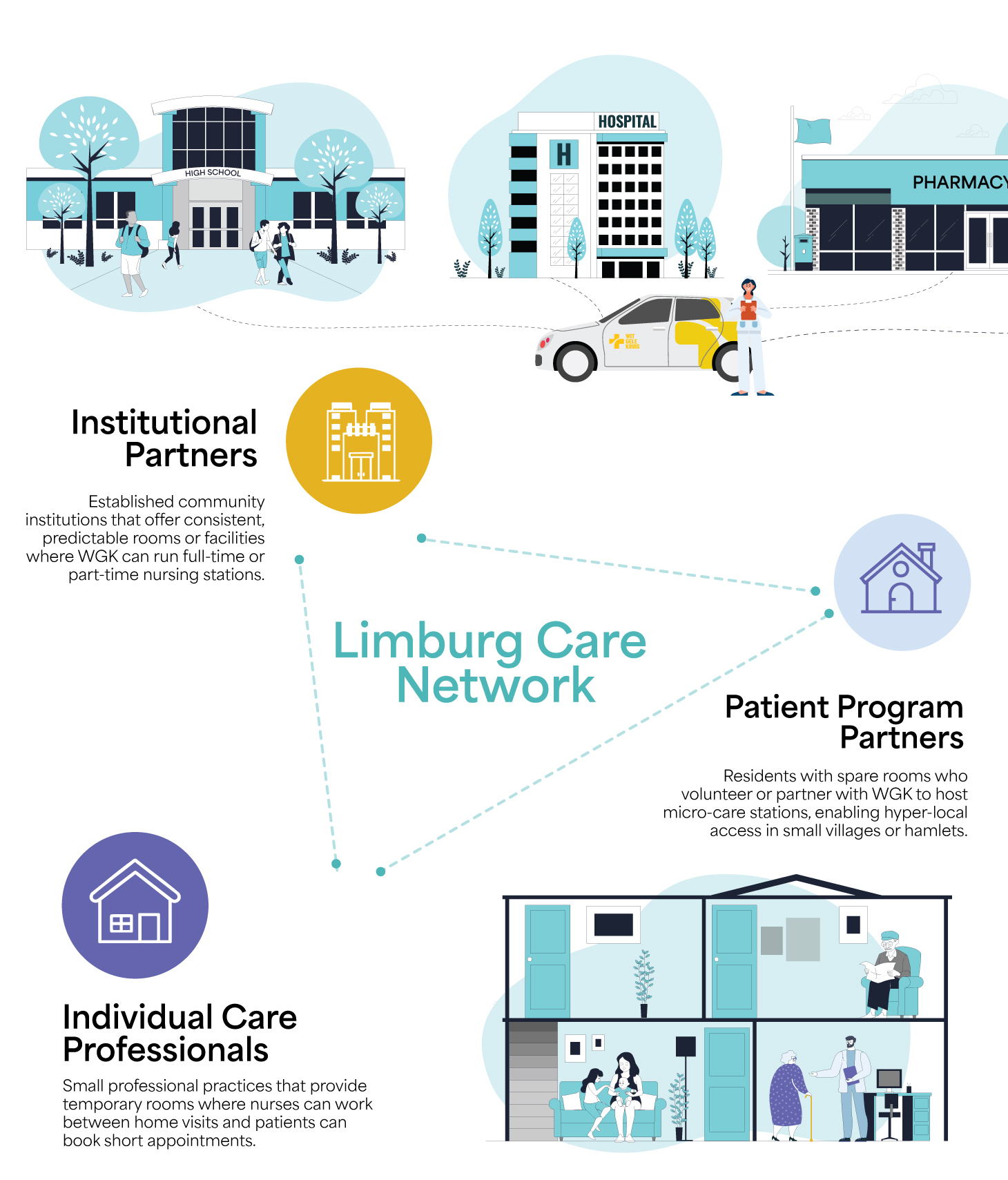
The proposed network: three partner types, one shared care infrastructure.
- Role
- Researcher & co-designer
- Fellow Designer
- Mohamed Adkaich
- With
- Wit-Gele Kruis
- Format
- Service-system proposal
- Duration
- 48 hours
- Year
- 2025
Context
They asked for a van. The need was a network.
Wit-Gele Kruis is one of the largest home-nursing organisations in Belgium. With an ageing population and a shrinking pool of nurses, they are stretched: more patients, longer distances, fewer hands and hours to cover them.
They came to us with a solution already in mind, a mobile medical van that would drive care into the villages. As we dug into the challenge, shadowing the rhythm of a nursing day, it became clear the van answered the symptom rather than the situation. A van is one more thing to buy, staff, fuel, park and maintain, and it can only ever be in one place at a time.
What they actually needed was a distributed network: care spread across rooms and relationships that already exist in Limburg, so that reach grows without depending solely on new material resources.
The problem
The care exists. The distance is the problem.
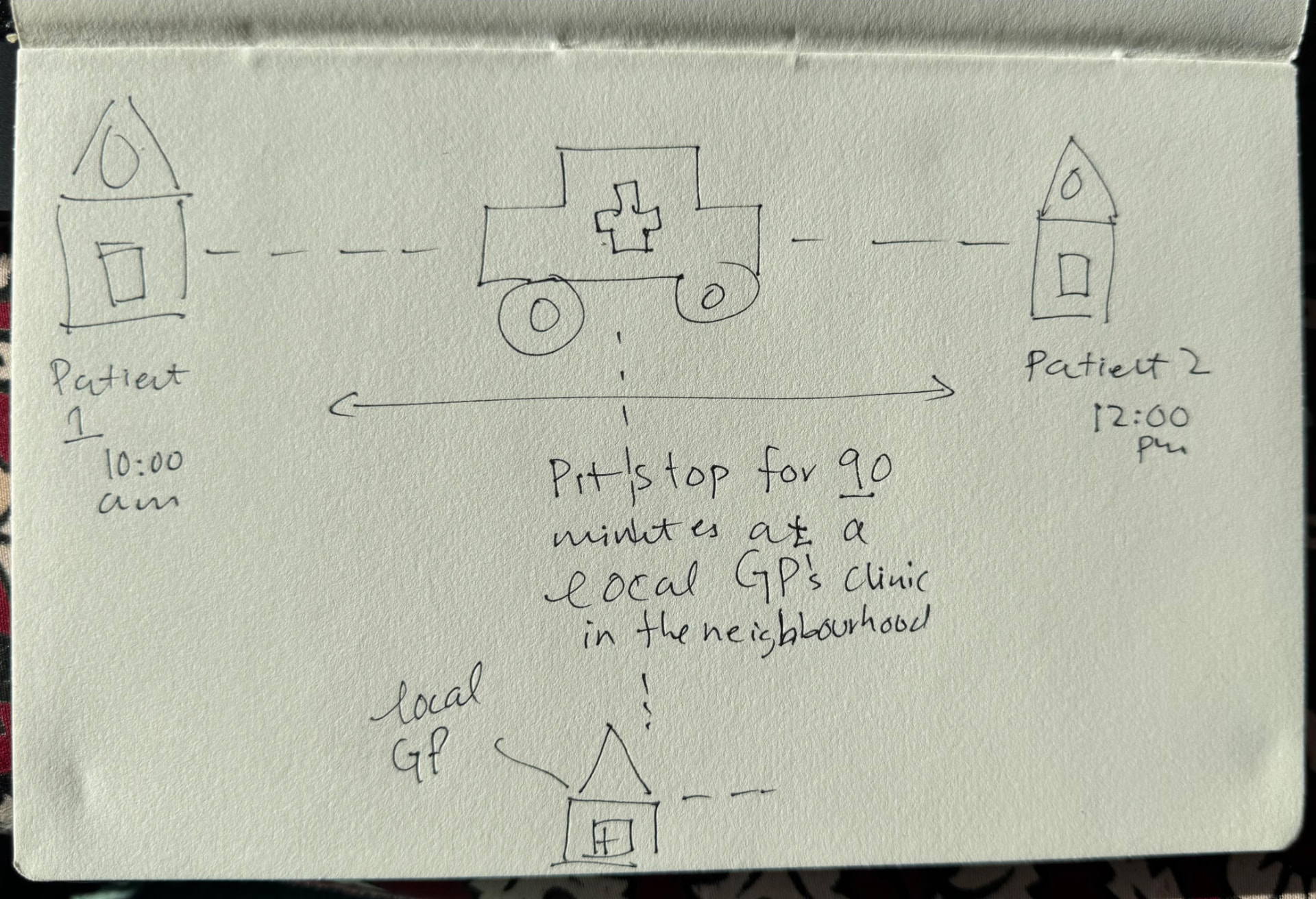
A nurse visits a patient at 10:00 in one village and the next at 12:00 in another. In between: driving, waiting, no room to work from, no place for a patient to drop in. Rural Limburg stretches the day thin, and the cost is absorbed by the nurses and by the patients who fall outside the route.
Approach
Start from what the region already has.
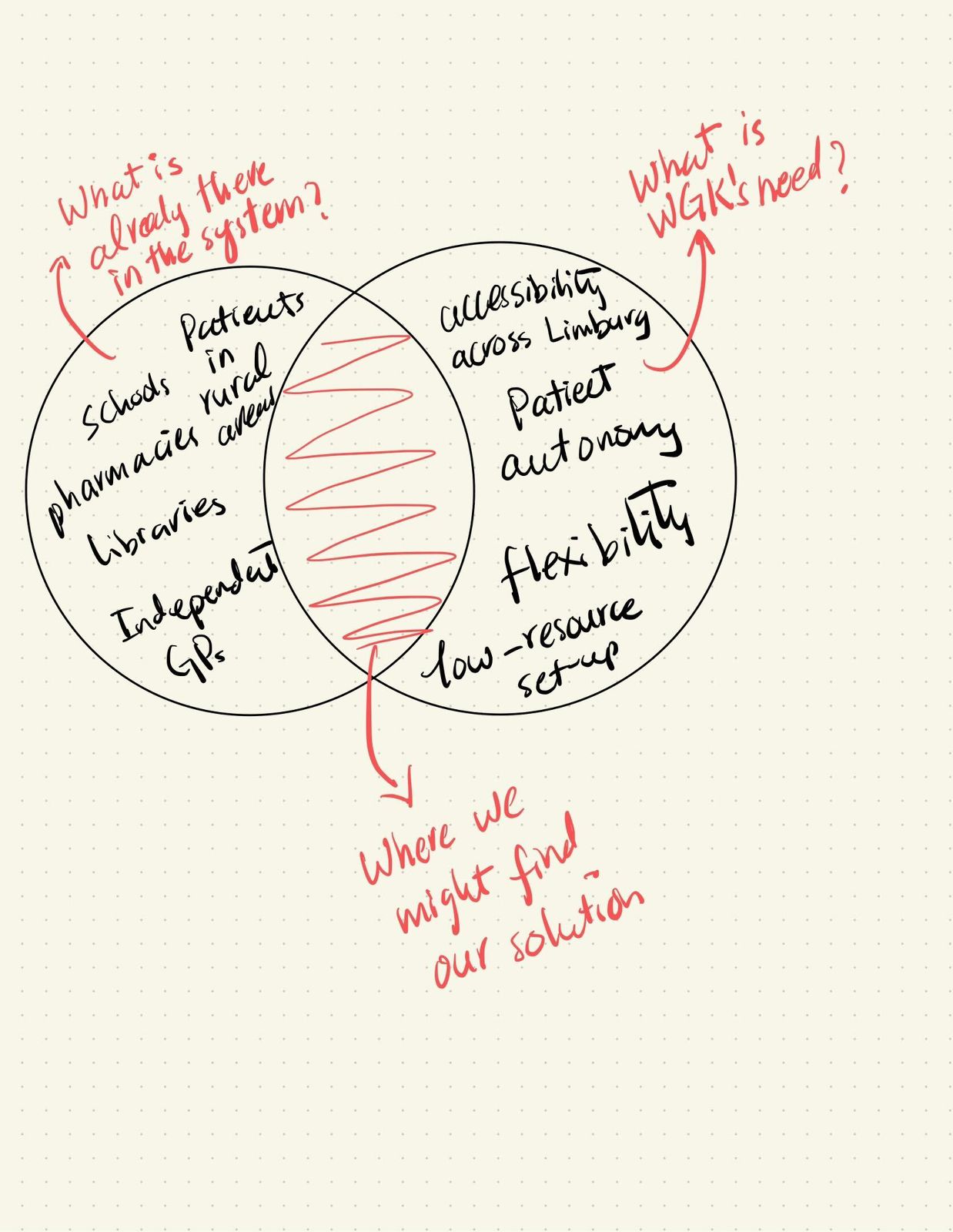
With two days, building something new was never an option, and it wasn't the right answer either. We mapped what already sits in the system and is already trusted: schools, pharmacies, libraries, independent GPs, and patients in rural areas with rooms that stand empty most of the day.
Against that we placed Wit-Gele Kruis's own needs: accessibility across Limburg, patient autonomy, flexibility, a low-resource setup. The solution lives in the overlap.
The network
Three kinds of partners, one shared protocol.
Rather than one type of location, the network works because it is uneven: a pharmacy in a town, a GP's spare consultation room, a neighbour's front room in a hamlet of two hundred people.
Wit-Gele Kruis
Home nursing
Institutional partners
Established community institutions with predictable rooms where nurses can run full- or part-time care stations.
- Pharmacies
- Libraries
- Schools
- Community centres
Individual care professionals
Small independent practices offering temporary rooms where nurses work between home visits and patients book short appointments.
- GP practices
- Physiotherapists
- Dentists
- Midwives
Patient program partners
Residents with a spare room who host micro-care stations, making care hyper-local in small villages and hamlets.
- Residents
- Village hosts
- Neighbours
One organisation, many hosts, care distributed across places that already exist.
Process notes
From a car journey to a system map.
- 01
Understanding the drive
Nurses were spending large parts of the day in the car between patients, a 10:00 visit in one village, a 12:00 visit in another, and ninety minutes of dead time in between with nowhere to work from.
- 02
Mapping what already exists
Instead of asking what was missing, we listed what Limburg already has: pharmacies, libraries, schools, independent GPs, and people in rural areas willing to open a room.
- 03
Finding the overlap
We placed the existing system against Wit-Gele Kruis's needs, accessibility across Limburg, patient autonomy, flexibility, a low-resource setup, and looked for where the two circles met.
- 04
Proposing the network
Three partner types, one shared protocol: a distributed care network that turns everyday spaces into accessible points of care, without building anything new.
Outcome
A care network that needs no new buildings.
A distributed care network proposal connecting pharmacies, libraries, schools, independent care professionals, and residents, turning everyday spaces into accessible points of care, and giving nurses somewhere to work between visits.
Reflection
Forty-eight hours is enough to change the question.
A sprint can't validate a service, but it can shift where you look. We started by asking how to bring care closer to people and ended up asking who in a neighbourhood is already willing to hold it. Trust turned out to be the real infrastructure, and it is already built.